
online-quran-teachers
Female Quran Teacher Online — Find a Qualified, Comfortable and Trusted Instructor for Every Learner
May
This article is published by The Quranic Institute — a trusted online Quran learning platform serving families across the USA, UK, Canada, and Australia.
Table of Contents
Finding the right female Quran teacher online can genuinely change how a student experiences Quranic education. Whether you are a mother searching for a patient instructor for your little girl, a revert sister who wants a safe and judgment-free space to learn, or a parent wanting proper Tajweed pronunciation for your children — the teacher you choose shapes everything.
This guide walks you through what makes a great female Quran instructor, what she teaches, how online sessions work in 2026, and how families across the USA, UK, Canada, and beyond can find a trusted one. A detailed FAQ section at the end answers the questions most parents ask before booking their first lesson.
Why A Female Quran Teacher Makes A Real Difference
For millions of Muslim girls, adult women, and young boys, a female Quran teacher is not just a preference — she is the right fit. Students who feel comfortable with their teacher ask more questions, stay more focused, and make faster progress. This is something Quran academies across the world have seen consistently over many years of running both mixed and same-gender classes.
Modesty-conscious education is deeply connected to Islamic values. Choosing a female instructor removes unnecessary discomfort, especially for students living in Western countries. When a learner does not have to manage social awkwardness during a lesson, she can put all her energy into recitation and understanding. Platforms like The Quranic Institute were built with exactly this in mind — creating a space where Muslim women and children can learn without barriers.
The Unique Role Of Women In Islamic Education Throughout History
Women have played a central role in Islamic knowledge since the very beginning. Aisha bint Abi Bakr (RA), the beloved wife of the Prophet Muhammad (peace be upon him), taught thousands of companions and is counted among the greatest hadith narrators in all of Islamic history. Female Islamic scholars, known historically as Muhaddithat, were respected, sought after, and regularly granted Ijazah — the formal chain of transmission for Quranic and hadith knowledge.
This tradition is alive and well in 2026. Ijazah-certified female Quran teachers are graduating from Al-Azhar in Egypt, renowned institutions in Jordan, Saudi Arabia, and across Pakistan. When you book lessons with a qualified female Quran instructor, you are not choosing a modern alternative. You are connecting your child to a living scholarly tradition that stretches back over 1,400 years.
وَقُل رَّبِ زِدنِي عِلمًا — “And say: My Lord, increase me in knowledge.” — (Surah Ta-Ha, 20:114)
Why Female Students And Children Learn Better With A Female Instructor
Research in educational psychology consistently shows that same-gender learning environments lower social anxiety, particularly for students between ages 8 and 18. When a teenage girl recites in front of a female teacher, she is far less self-conscious than she would be with a male instructor. That comfort directly translates into better attention, more practice, and faster improvement.
For adult Muslim women learning Quran for the first time, the emotional stakes are even higher. Many carry years of guilt about not having learned earlier. A female Quran teacher who specializes in adult learners understands this and builds her teaching style around making every lesson feel encouraging, not exposing.
Cultural Comfort, Modesty, And Trust — Why It Matters In Quranic Learning
In South Asian and Middle Eastern households, women and girls have traditionally received religious education from other women. This is not just cultural habit — it reflects the Islamic value of hayaa, which encompasses decency, self-respect, and modesty in all aspects of life. Choosing a female Quran instructor honors that value directly.
Trust is the other half of this equation. Parents raising children in non-Muslim majority environments want complete confidence in who is teaching their kids. A credentialed female Quran teacher from a transparent, verified platform — like The Quranic Institute — comes with verifiable qualifications and a track record parents can check before the very first lesson.
How Female Teachers Create A More Open And Encouraging Classroom Environment
The best female Quran teachers do not just correct mistakes — they explain them. They show the student where the tongue should sit, how the throat should sound, and then invite her to try again in a relaxed, low-pressure way. That approach is especially important in Tajweed, where a single letter can make or break the meaning of a verse.
This open classroom culture also matters deeply in Hifz programs. Memorizing the Quran takes months or years of daily effort, and students who trust their teacher are far more likely to finish what they start. The best female Hifz teachers become genuine mentors across that journey, not just instructors.
What To Look For In A Qualified Female Quran Teacher
Not every female teacher offering Quran classes online is equally prepared. The online Quran learning space has grown fast since 2020, which means there is now a wide range in quality. Before you pay for a single session, knowing what separates a truly qualified female Quran teacher from someone who simply recites well is essential.
Start with the Ijazah. This is a formal Islamic certification — not a weekend course certificate — granted by a recognized scholar confirming that the teacher’s recitation is error-free and she has permission to teach. Without it, you are trusting her self-assessment, which is not a reliable enough standard when the Quran is involved.
Academic Background And Islamic Credentials (Ijazah, Hifz, Tajweed Certification)
A genuine Ijazah is the gold standard. Many of the best online female Quran teachers at The Quranic Institute hold Ijazah in the Hafs an Asim recitation — the most widely used mode of Quran recitation globally. This means their chain of knowledge connects directly back to the Companions of the Prophet (peace be upon him).
Hifz completion and a formal Tajweed certification from a recognized institution are strong bonus credentials. A teacher who has memorized the Quran herself knows exactly where students struggle and which surahs require the most careful revision. That personal experience is something no amount of theoretical teaching training can replace.
Teaching Experience With Kids, Adults, And Beginners
Ask any potential teacher directly: “Have you taught complete beginners? What is the youngest student you have worked with? Have you ever taught adult reverts?” These three questions alone will tell you whether she has the practical tools your student needs.
Teaching a six-year-old and teaching a 35-year-old revert require entirely different approaches. Children need shorter sessions, more games, and lots of encouragement. Adults need emotional sensitivity, detailed explanations, and a teacher who never makes them feel childish for not knowing something. Experience with your specific type of learner is non-negotiable.
Ability To Teach In Your Native Language (Urdu, Arabic, English)
Language of instruction matters far more than most parents realize. An Urdu-speaking Quran teacher is often significantly more effective for South Asian families than one who teaches only in English. Arabic-speaking families benefit from a teacher who explains Tajweed rules in Arabic. Families in North America or Australia generally need clear, confident English instruction paired with correct Quranic Arabic pronunciation.
Many certified female Quran teachers at The Quranic Institute are genuinely multilingual, able to switch between Arabic, English, and Urdu within a single lesson based on where the student needs the most clarity. That flexibility is a meaningful advantage for international families.
Patience, Communication Style, And Student Feedback
Watch how a teacher responds the third or fourth time a student makes the same mistake. Does she re-explain differently? Does she sound patient? Does she give encouragement alongside the correction? These small moments define whether a student enjoys class or begins dreading it.
Good teachers also communicate with parents between lessons — short updates, progress notes, early warnings when a student is struggling. Before committing to anyone, ask for references or read reviews from other families. A teacher with years of experience and no student feedback at all is worth treating with caution.
Red Flags To Watch Out For When Hiring A Quran Teacher Online
Clear red flags include: a teacher who cannot demonstrate her own Tajweed during a trial, someone who pressures you into a multi-month payment plan before you have evaluated her teaching, and anyone who cannot produce verifiable credentials on request.
Subtler warning signs include unrealistic promises (“Your child will memorize Juz Amma in two weeks”), defensiveness when asked about Ijazah, and no visible lesson structure or curriculum. Prices that seem unusually low can also signal oversized group classes being sold as private tuition, or teachers who will not stay long enough to give your student the consistency they need.
Courses Typically Offered By An Online Female Quran Teacher
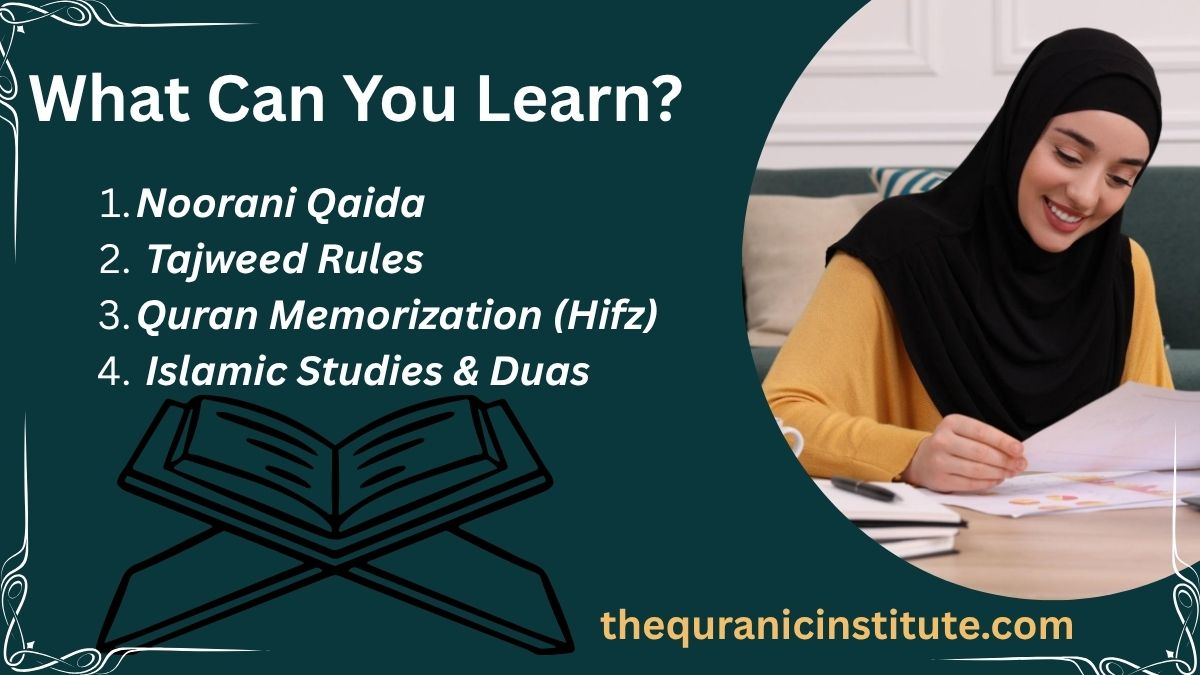
A well-rounded female Quran teacher offers a structured ladder of courses that takes a student from complete beginner to confident, accurate Quran reader — and beyond. Understanding what is available helps you choose the right starting point and plan the full journey realistically.
| Course | Best For | Average Duration |
|---|---|---|
| Noorani Qaida | Complete beginners — children and adults | 3 to 6 months |
| Basic Tajweed | Students who can read basic Arabic | 4 to 8 months |
| Advanced Tajweed | Fluent readers seeking accurate recitation | 6 to 12 months |
| Hifz Program | Students committed to full memorization | 1 to 5 years |
| Tafseer and Translation | Intermediate to advanced readers | Ongoing |
| Islamic Studies and Duas | Young children aged 4 to 10 | Ongoing |
| Arabic Language Course | Beginners to intermediate learners | 6 to 18 months |
Quran Reading For Absolute Beginners (Noorani Qaida / Basic Tajweed)
Noorani Qaida, developed by Maulvi Noor Muhammad Haqqani, has been the world’s most trusted beginner Quran reading curriculum for over a century. It introduces Arabic letters, their sounds, joined forms, and the symbols (harakat) that control vowel sounds in the Quran — in a carefully sequenced way that genuinely works for complete non-readers.
A qualified female Quran teacher does not simply have students repeat letters. She listens to every sound and physically coaches tongue and throat placement for letters like Ain, Ghayn, and Kha that have no English equivalent. For young children, sessions run 20 to 30 minutes with visual aids and encouragement. For adult beginners, the same content is taught with more detailed explanation and the patience that adult learning genuinely requires.
If you are completely new to Quran reading, you may also benefit from reading our detailed beginner guide: How to Read the Quran Correctly for Beginners: 7 Simple Steps
Tajweed Rules — Perfecting Pronunciation And Recitation
خَيْرُكُمْ مَنْ تَعَلَّمَ الْقُرْآنَ وَعَلَّمَهُ — “The best among you are those who learn the Quran and teach it.” — (Sahih Al-Bukhari, 5027)
Tajweed is the science of reciting the Quran as it was revealed — covering rules like Idgham, Ikhfa, Madd, and Qalqalah that govern how letters sound in different positions within a verse. Millions of Muslims recite the Quran daily without realizing they are making consistent pronunciation errors. A certified female Quran teacher can identify those errors within a single lesson and begin correcting them systematically.
Online Tajweed classes are highly effective because both teacher and student interact via live video, allowing real-time feedback on every syllable. Screen-sharing tools let teacher and student read the same mushaf simultaneously, with the teacher pointing out rules as they appear in the actual recitation.
Quran Memorization (Hifz) Program For Kids And Adults
Completing Hifz — memorizing the entire Quran — is one of the most honored achievements in Islam, earning a person the title of Hafiz or Hafiza. The process typically takes one to five years depending on age, daily commitment, and teaching quality. A strong female Hifz teacher understands that memorization is as much a spiritual and emotional journey as an academic one.
Children typically follow a daily structure of new memorization (sabaq), recent lesson review (sabqi), and older revision (manzil). Adult Hifz is increasingly popular too — especially among Muslim women who never had the right opportunity in childhood. Even 30 to 45 minutes a day, guided well by a skilled teacher at The Quranic Institute, is enough to build steady, lasting progress.
Tafseer And Quran Translation For Deeper Understanding
Reciting the Quran correctly is the first goal. Understanding what it actually says is the next, and for many Muslim families it is the missing piece. Tafseer is the classical discipline of Quranic interpretation — examining the meaning of verses, the circumstances of their revelation, and what generations of scholars have understood from them.
Female Quran teachers offering Tafseer classes typically teach from trusted texts like Ibn Kathir or Tafseer Jalalayn, explained in the student’s preferred language. Most teachers recommend completing at least basic Tajweed before starting Tafseer — trying to analyze a text you cannot yet read reliably produces very little genuine understanding.
Islamic Studies, Duas, And Sunnah For Young Learners
For children between ages four and ten, Quran recitation works best when it is paired with a broader Islamic studies curriculum. This includes the five pillars, essential daily duas, basic aqeedah, and stories of the prophets — all taught in a way that makes the Quran feel immediately connected to everyday life.
When a six-year-old learns Surah Fatiha and also understands that she recites it in every rakat of salah, both pieces of knowledge reinforce each other and stick far better. Female Quran teachers who specialize in early years learning understand this instinctively, and the best ones weave these connections into every lesson naturally.
Arabic Language Classes Alongside Quranic Studies
Tajweed teaches correct pronunciation. Arabic language classes teach vocabulary, grammar, and the ability to understand what is being recited. Together, they give a student the tools to connect with the Quran directly — not just recite it, but genuinely understand it without depending on a translation.
Many female Quran teachers at The Quranic Institute now offer combined Tajweed and Quranic Arabic packages. Learning Arabic alongside Quran also makes Tajweed progress faster — students who recognize a word feel more confident when they encounter it in a new surah, and confidence speeds up fluency significantly.
How Online Female Quran Classes Work — A Step-By-Step Overview
Online Quran learning in 2026 is smoother and more reliable than it has ever been. Most families go from first inquiry to their first live session within a few days. The key decisions — platform vs. private teacher, one-on-one vs. group, scheduling your time zone — are straightforward once you know what to look for.
The process almost always begins with a free trial lesson. That single session is the most valuable step in the entire process. It tells you more about whether a teacher is the right fit than any credential document or written review ever could.
Choosing A Platform Or Academy Vs. Hiring A Private Teacher
An established online Quran platform like The Quranic Institute offers vetted teachers, structured curricula, payment systems, and substitute teachers if your regular instructor is unavailable — giving families real stability and accountability.
Hiring a private teacher through referral platforms offers more flexibility but puts all the credential-checking and quality control entirely on you. For families new to online Quran learning, starting with a structured academy is almost always the smarter first step. You can always transition to a trusted private teacher later once you know exactly what good teaching looks like.
The Free Trial Lesson — What To Expect And How To Evaluate A Teacher
Approach the free trial the same way you would approach hiring someone for an important job. Ask the teacher to show her Ijazah. Ask her to recite a short passage so you can hear her own Tajweed quality. Watch how she interacts with your child in the first five minutes — does the child seem relaxed? Is the teacher genuinely curious about where the student is, or is she going through a scripted routine?
After the session, ask your child one simple question: “Did you like her?” For young students especially, that gut response is often more accurate than any formal evaluation. A child who says “I want to go again” has just told you everything you need to know.
Scheduling Flexibility For Students In The USA, UK, Canada, And Pakistan
Time zone management is one of the most practical challenges of international online Quran classes. A teacher in Pakistan is typically 9 to 10 hours ahead of the US East Coast. Most reputable academies, including The Quranic Institute, staff their teachers on shift schedules specifically designed to serve North American and European families during their evening hours.
For US families, a 6:00 PM to 9:00 PM Eastern slot often matches early morning in Pakistan — when teachers are freshest and most focused. For UK families, the overlap is more natural. Always confirm your exact preferred time slot is genuinely and consistently available before making any payment commitment.
Tools Used In Online Sessions (Zoom, Skype, Google Meet, Dedicated Portals)
Most online Quran sessions run on Zoom, which remains the most stable and widely available video platform for live teaching globally in 2026. Screen sharing allows both teacher and student to read the same mushaf in real time, with the teacher highlighting rules as the student recites.
Some larger academies run their own proprietary classroom portals with built-in session recording, lesson notes, and parent progress dashboards. These extra features are worth asking about — especially for parents who want transparency into what happens during each session. A reliable internet connection on both sides is non-negotiable for Tajweed work, where every syllable needs to be heard clearly.
One-On-One Vs. Group Classes — Which Format Suits You Best
One-on-one Quran lessons are almost always more effective for beginners, Tajweed students, and anyone working on Hifz. Quran recitation is an individual skill — every student makes different errors, and correction needs to happen in real time, for every word. In a group class, that level of individual attention is simply not possible.
Group classes work well for Tafseer discussions, Islamic studies, and Arabic vocabulary — where multiple perspectives and questions genuinely enrich the learning. For most families, the ideal combination is private sessions for Quran reading and Tajweed, with optional group classes for Tafseer or Islamic studies if your academy offers them.
Female Quran Teacher Near Me — Local Vs. Online: Which Is Better In 2026?
Consider this scenario: you are a mother in Houston, Texas. Your seven-year-old daughter has been asking to learn Quran. You search “female Quran teacher near me” and find two choices — a local teacher at the nearby masjid on Tuesday and Thursday evenings, or a certified female instructor through The Quranic Institute available six days a week at times that actually fit your family’s schedule. Which do you choose?
In 2026, for most families the answer is online — not because local teachers lack quality, but because availability, scheduling flexibility, credential verification, and one-on-one instruction are all significantly stronger through a well-run online platform. Local teachers remain valuable for very young children under five or learners with specific needs requiring physical presence. For the majority of school-age students and adults, online is not the backup plan anymore. It is the better plan.
Why Online Female Quran Teachers Are Outpacing In-Person Options
Online Quran academies have seen strong and consistent student growth since 2020, with female teacher requests emerging as one of the fastest-growing categories. Muslim families in North America, Europe, and Australia are driving this growth because local options simply cannot meet the demand for qualified, one-on-one female instruction.
Online academies have also built quality control systems that most local teachers cannot match — Ijazah verification, structured lesson plans, session recording, and regular parent updates. The wide scheduling availability that platforms like The Quranic Institute now offer is something no individual local teacher can realistically provide.
Female Quran Teacher USA — What American Muslim Families Should Know
The Muslim population in the United States is estimated at approximately 3.5 million according to Pew Research, and continues to grow steadily. In cities like New York, Houston, Chicago, Los Angeles, and Dearborn, demand for qualified female Quran instructors is real and growing. But even in these high-density Muslim areas, finding a one-on-one certified female teacher locally is genuinely difficult.
Most American Muslim families in 2026 are accessing female Quran teachers through online platforms — and for good reason. The world’s best certified Quran teachers are concentrated in Egypt, Pakistan, Saudi Arabia, and Jordan. Online learning connects American families directly to these teachers from home, without compromising on quality, credentials, or scheduling convenience.
Female Quran Teacher UK — What British Muslim Families Should Know
The United Kingdom is home to one of Europe’s largest and most established Muslim communities, with millions of Muslims across England, Scotland, Wales, and Northern Ireland. Cities like London, Birmingham, Bradford, and Manchester have significant demand for qualified female Quran teachers — yet even here, finding a verified, one-on-one certified instructor locally remains a real challenge for many families.
British Muslim families increasingly turn to online platforms for their children’s Quranic education. The time zone overlap between the UK and Pakistan is far more manageable than for US families — Pakistan Standard Time (PKT) is only 4 to 5 hours ahead of GMT — making evening sessions in the UK perfectly aligned with morning slots for Pakistan-based teachers.
For UK families, The Quranic Institute provides certified female Quran teachers experienced with British-born students, including second and third-generation Muslims who may speak English as their primary language. All explanations, corrections, and Tajweed guidance are delivered in clear English, while the Quranic text is always taught in Arabic.
Female Quran Teacher Egypt — Al-Azhar Certified Instructors Online
Egypt is home to Al-Azhar University — one of the oldest continuously operating universities in the world and the most respected centre of Islamic scholarship globally. Egyptian female Quran teachers who hold Al-Azhar affiliated Ijazah carry credentials that are recognized and trusted by Muslim scholars across every continent.
The Al-Azhar Ijazah chain means a teacher’s recitation has been evaluated, corrected, and certified in an unbroken chain stretching back to the Prophet Muhammad (peace be upon him) himself. When you choose a female Quran teacher from Egypt with Al-Azhar credentials, you are not simply hiring a private tutor — you are connecting your family to over a thousand years of verified Islamic scholarly tradition.
Egyptian female Quran teachers are particularly sought after for their Tajweed precision, classical Arabic pronunciation, and deep familiarity with the Hafs an Asim recitation. Families in the USA, UK, Canada, and Australia consistently rate Egyptian instructors among the highest for recitation accuracy and teaching clarity. The Quranic Institute connects families directly to verified Egyptian teachers without the need for travel or local searching.
Female Quran Teacher Pakistan — Why Pakistani Instructors Lead Globally
Pakistan has one of the world’s largest and most active Quran education communities. Hundreds of thousands of students graduate from Pakistani madaris and Islamic institutions every year, many holding formal Ijazah certification from respected scholars. Pakistani female Quran teachers are among the most experienced in the world when it comes to teaching international students — particularly families from South Asian backgrounds living in the USA, UK, Canada, and Australia.
Pakistani female Quran teachers bring a combination of deep Tajweed training, Hifz experience, and natural multilingual ability — teaching comfortably in Arabic, Urdu, and English within the same lesson. For South Asian Muslim families abroad, a Pakistani teacher often provides the most culturally comfortable, linguistically accessible, and academically rigorous learning experience available.
The time zone structure also works well for Western families. A Pakistani teacher working early morning hours (5:00 AM to 10:00 AM PKT) aligns perfectly with evening slots in the US East Coast and afternoon slots across the UK. The Quranic Institute’s Pakistan-based female teachers serve hundreds of international students with consistent scheduling, verified Ijazah credentials, and a teaching style shaped by decades of experience with cross-cultural learners.
Cost Of Hiring A Female Quran Teacher
Pricing varies based on teacher location, credentials, session frequency, and whether classes are private or group format. Here is a realistic comparison for 2026:
| Teacher Type | Monthly Cost (Approximate) | Sessions Per Month |
|---|---|---|
| USA-based private teacher | $150 to $300 | 8 to 12 sessions |
| UK-based academy teacher | $80 to $150 | 12 to 16 sessions |
| Pakistan-based online teacher | $40 to $80 | 16 to 24 sessions |
| Egypt-based certified teacher | $50 to $100 | 16 to 24 sessions |
The goal is never the cheapest option — it is the most qualified teacher your family can sustain long enough to see real results. Quran learning takes months or years. Consistency with the right teacher is worth more than the lowest price.
How To Get Started — Hiring Your Female Quran Teacher Today
Getting started is simpler than most families expect. In most cases, you can go from first search to first lesson within a week. The key is starting with clarity — write down the student’s current level, the goal (basic reading, Tajweed, Hifz, or understanding), how many weekly sessions are realistic, your budget, and what language of instruction you need.
Those five questions alone will narrow your search dramatically. Head to The Quranic Institute to explore certified female teachers, check available time slots for your region, and book a free trial with no upfront commitment required.
Questions To Ask Before Booking A Session
Before committing to any teacher, ask these directly:
- Do you hold an Ijazah, and from which scholar or institution?
- How long have you been teaching, and what age groups do you have the most experience with?
- What curriculum would you use for a student at my child’s current level?
- How do you handle a student who keeps making the same mistake?
- How do you communicate with parents between sessions?
- Do you offer a free trial lesson before I commit to a package?
A teacher who answers these questions confidently and specifically — without deflecting or getting defensive — is worth taking seriously.
Tracking Progress — How To Know The Teacher Is The Right Fit
After four to six weeks, you should see measurable movement. A beginner should be progressing through Noorani Qaida. A Tajweed student should be able to name and demonstrate a handful of rules. A Hifz student should have a clear daily memorization and revision routine.
If six weeks pass with no visible improvement, and your child does not look forward to lessons — this is not a failure on your child’s part. It is a sign the teacher is not the right match. Switching teachers is not quitting. It is responsible parenting.
Frequently Asked Questions (FAQ)
What Is A Female Quran Teacher Called In Islam?
A female Quran teacher is called a Mu’allimah (معلمة), the feminine Arabic word for teacher. At higher scholarly levels, she may also be addressed as Ustadha or Shaykha — titles that carry deep respect in the Islamic academic tradition and reflect real knowledge and verified credentials.
Can A Female Teach Quran To Male Students?
Yes. Most scholars agree it is permissible for a female Quran teacher to teach young boys. For adult male students, scholarly opinions vary by madhab and cultural context. Many online platforms do facilitate female-to-male Quran instruction for adult men who prefer it, with appropriate screen-based interaction protocols in place.
Is It Permissible (Halal) To Learn Quran Online From A Female Teacher?
Yes, completely. Scholars across different madhabs have confirmed that online Quran learning is permissible. The conditions — a qualified teacher, proper screen-based interaction, appropriate learning environment — are fully met through any reputable platform. Millions of Muslim women and children learn Quran this way in 2026.
What Age Is Best To Start Quran Lessons With A Female Teacher?
Most Quran educators recommend starting between ages four and six, when children can sit and focus for 20 to 30 minutes. Early learning builds clean pronunciation habits that are much harder to form later. That said, there is genuinely no upper age limit — adult beginners in their 50s, 60s, and beyond have learned to recite and memorize with the right teacher. The best time to start is right now.
What Qualifications Should A Female Quran Teacher Have?
The minimum standard is Ijazah certification in Quran recitation and verifiable teaching experience with your student’s age group and level. Strong additional credentials include Hifz completion and a formal Tajweed certification from a recognized institution. Always ask to see these credentials before committing to any teacher.
How Do I Choose The Best Female Quran Teacher For My Child?
Verify her Ijazah. Book a free trial. Watch the first ten minutes carefully — does your child seem relaxed? Does the teacher seem genuinely interested? Ask your child how they felt afterward. A teacher who gives honest, constructive feedback rather than empty praise is a teacher worth keeping.
How Much Does An Online Female Quran Teacher Charge Per Month?
Typically between $40 and $300 per month depending on teacher location, credentials, and session frequency. Egypt-based and Pakistan-based certified teachers generally range from $40 to $100 monthly for multiple weekly sessions. USA-based or UK-based instructors usually charge more. Always compare session length and frequency before comparing prices.
How Long Does It Take To Learn To Read The Quran Properly?
With consistent lessons and daily practice, most students complete Noorani Qaida in three to six months and develop fluent basic Quran reading within one to two years. Adding solid Tajweed proficiency typically takes another six to eighteen months of focused work. Students who practice only during class sessions will take considerably longer than those who review between lessons too.
How Long Does It Take To Learn Tajweed With A Female Quran Teacher?
Basic Tajweed rules can be introduced within three to four months. Applying them consistently in smooth recitation typically takes six to eighteen months. Reaching a level where your recitation is accurate enough to pass a formal evaluation usually requires two or more years of regular, daily practice.
Can Non-Arabic-Speaking Students Learn From A Female Quran Teacher Online?
Absolutely. Most Muslims globally are not native Arabic speakers, and experienced female Quran teachers work with this reality every day. The Quran is taught in Arabic regardless of the student’s native tongue, but all explanations, corrections, and feedback are delivered in the student’s most comfortable language — whether that is English, Urdu, French, Bengali, or another language entirely.
Are There Certified Female Quran Teachers From Egypt Or Pakistan Available Online?
Yes, and they are among the most highly sought-after teachers in the world. Egyptian female teachers often hold credentials connected to Al-Azhar University — the world’s oldest and most respected Islamic institution. Pakistani female teachers frequently hold Ijazah from renowned scholars and are deeply experienced with international students. Both are available through The Quranic Institute and serve families across North America, Europe, and Australia.
How To Book A Female Quran Teacher For Kids Online?
Visit The Quranic Institute at thequranicinstitute.com, choose a female teacher, select your child’s level and preferred time slot, fill out a short registration form, and confirm a free trial date. The whole process takes less than 15 minutes, and you receive a session link by email shortly after.
What Is The Difference Between A Private And Group Female Quran Class?
Private classes are one-on-one, allowing fully personalized correction, pacing, and curriculum. Group classes involve multiple students and work better for content-based subjects like Tafseer or Islamic studies. For Quran reading and Tajweed, private sessions almost always produce better and faster results.
Is It Safe For My Daughter To Learn Quran Online With A Female Teacher?
Yes. Reputable academies like The Quranic Institute record sessions for quality assurance and maintain transparent teacher vetting processes. Parents are encouraged to sit in during early lessons. Choosing a platform that communicates openly with parents is the single best safety measure you can take.
Can A Female Quran Teacher Teach Tajweed And Arabic Together?
Yes. Many qualified female Quran teachers offer combined Tajweed and Quranic Arabic programs. This combination is particularly effective for students who want to eventually understand what they are reciting. Ask specifically whether your preferred teacher offers both when you book your trial.
Are There Female Quran Teachers Available For Beginners In The USA?
Yes, through online platforms. The Quranic Institute gives American families access to a broad pool of certified, experienced beginner-level instructors — far more than any local market can realistically provide.
Final Takeaway
New students and parents can also explore our beginner-friendly guide: How to Read the Quran Correctly for Beginners: 7 Simple Steps .
A female Quran teacher is not simply a preference — for millions of Muslim learners, she is the teacher who makes learning the Quran feel possible, safe, and meaningful. Whether you are searching for a qualified female Quran teacher in the USA, looking for Al-Azhar certified instructors from Egypt, experienced Pakistani instructors, or trusted teaching for the UK — the right person is available right now.
Do not overthink the starting point. Head to The Quranic Institute, book your free trial, show up prepared, and watch the first lesson with an open mind. The teacher who connects with your student, maintains real structure, and shows up consistently every week — that is the one worth keeping. And the results: accurate Tajweed, steady Hifz progress, and a growing love for the Quran — will speak for themselves.
مَنْ سَلَكَ طَرِيقًا يَلْتَمِسُ فِيهِ عِلمًا، سَهَّلَ اللَّهُ لَهُ بِهِ طَرِيقًا إِلَى الْجَنَّةِ — “Whoever travels a path seeking knowledge, Allah will make easy for him a path to Paradise.” — (Sahih Muslim, 2699)
May Allah make the path of Quranic learning easy for every student and every family seeking it. Ameen.
About The Author
Written by Hafiza Asma
Hafiza • Alima • Master in Islamic Studies • SEO Content Specialist
Hafiza Asma has over 10 years of experience teaching Quran and Islamic studies to students across the USA, UK, Canada, and Australia. Through her teaching experience and work with qualified male and female Quran instructors, she focuses on making Islamic education simple, engaging, and comfortable for students of different age groups. Lessons are designed using age-appropriate language, real-life examples, and interactive learning techniques to help students understand and remember lessons effectively while learning with confidence and interest.
Visit us at: https://thequranicinstitute.com/
