
Quran Learning
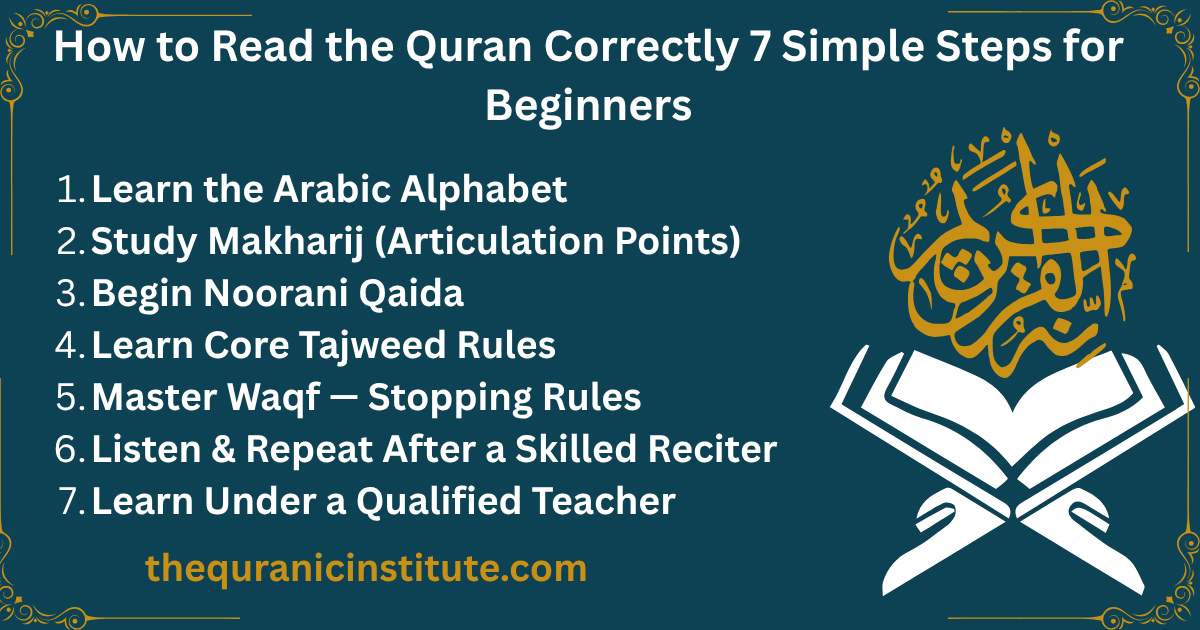
How to Read the Quran Correctly for Beginners: 7 Simple Steps
May
Quick Answer: If you want to read the Quran as a beginner, start by learning the Arabic alphabet and short vowels. Then study how to make Arabic letters sound correct and work through a book that teaches you how to read. A good teacher can help you learn the rules. Try to practice every day for 15 to 30 minutes and listen to people who recite the Quran well. This helps a lot.
Most beginners make the mistake. They open the Quran, try to say the letters, and think that reading the words is enough. It is not.
Reading the Quran correctly is a skill, a science, and for Muslims, a very personal journey. I have been teaching people how to recite the Quran for some time. To kids as young as four, to adults, and to new Muslims. Every single one of them started like you: at the beginning with an intention.
The good news? With the steps, anyone can learn how to read the Quran correctly. You can do it step by step and do it in a way that honors the Quran. This guide covers everything: from your first letter to building a daily habit.
The Spiritual Weight Behind Every Letter
The Spiritual Reward of Proper Recitation
Allah does not just want you to recite beautifully. He commands it in the Quran:
“Recite the Quran with measured, distinct recitation.”
This is not a suggestion. It is an instruction. When I share this with my students on their day, I see a change in how they hold the Quran. With more care. They know what they are about to do is sacred.
If you are worried that you are far behind, the Prophet Muhammad addressed that fear a long time ago:
“The one who is good at reciting the Quran will be with good people, and the one who recites it with difficulty will have a double reward.”
That hadith gives a lot of comfort. Even struggling counts. If you are trying to get it right. There is a meaning behind every letter.
Allah also says in the Quran about those who truly commit to His Book:
Arabic: الَّذِينَ يَتْلُونَ كِتَابَ اللَّهِ وَأَقَامُوا الصَّلَاةَ وَأَنفَقُوا مِمَّا رَزَقْنَاهُمْ سِرًّا وَعَلَانِيَةً يَرْجُونَ تِجَارَةً لَّن تَبُورَ
Reference: Surah Fatir, 35:29
English Meaning: “Indeed, those who recite the Book of Allah establish prayer and donate from what We have provided them secretly and openly. They can hope for a profit that will never perish.”
When you recite the Quran with Tajweed, it is like you are doing something for Allah. Many scholars have said that when you recite the Quran correctly, it is like you are talking to Allah. If you just read the Quran fast. Do not care about how you are saying the words, it is not the same.
What happens when you say words incorrectly?
The Arabic language is very precise. If you change one letter, it can change the meaning of the word. I remember one student who was learning the Quran. She was saying the letter ق like a “k” sound. She was doing this for months before we found out. She was very sad when she found out. She learned a lot from this. She learned that saying the words correctly is very important.
This is not something that happens once in a while. It happens a lot. This is why Muslims have always tried to say the words of the Quran for over 1,400 years.
Do you have to read the Quran with Tajweed?
Imam Ibn al-Jazari was a smart man who knew a lot about the Quran. He said that you have to say the Quran with Tajweed. If you do not do this, you are doing something.
Other scholars say that it is okay if you are trying to learn. Allah is kind to people who are trying to do the right thing. Not knowing how to say the words correctly is not an excuse. It is the beginning. You can always start to learn.
What does it mean to read the Quran?
There is a difference between reading the Quran and reciting the Quran. Reading the Quran means you can see the words and say them. Reciting the Quran means you say the words correctly. With feeling. Both are important. Reciting the Quran is better. You can read a word. Still say it incorrectly.
In my experience, students who understand this difference do much better than those who think they are reading the Quran when they are actually just reading symbols on a page. When you recite, you need to use your voice, your breath, and pay attention.
What is Tajweed. Why Every Beginner Needs It
Tajweed basically means making something. As a discipline, it is the set of rules that govern how each Arabic letter is pronounced, elongated, merged, or clarified when reciting the Quran. It covers things like where your tongue touches your palate and how long you hold a vowel sound.
The Quran says about those who truly honor the Book:
الَّذِينَ آتَيْنَاهُمُ الْكِتَابَ يَتْلُونَهُ حَقَّ تِلَاوَتِهِ أُولَٰئِكَ يُؤْمِنُونَ بِهِ
Reference: Surah Al-Baqarah, 2:121
English Meaning: “Those to whom We have given the Book recite it as it truly deserves to be recited. It is they who truly believe in it.”
Notice that truly believing in the Book is connected to how you recite it. Tajweed is not just something; it is the foundation of reading the Quran correctly.
Tarteel vs. Hadr vs. Tadweer. Which Pace Should Beginners Use?
There are three recognized paces of recitation.
Tarteel is slow and measured. It’s the pace Allah commands in Surah Al-Muzzammil.
Hadr is fast and used by reciters who know the rules well.
Tadweer is between the two.
For beginners, Tarteel is the choice. I’ve seen students try to imitate their reciter at full speed and end up making more mistakes. At this stage, speed can actually make you less accurate. You will naturally speed up. Correctly. As the rules become second nature.
What You Need Before You Begin (Beginner Checklist)
Do You Need to Know First?
No, you don’t. Many people who don’t speak Arabic learn to recite the Quran precisely without becoming fluent in conversational Arabic. Recitation is a skill of understanding language. At first, you’re learning sounds and rules. Not grammar or vocabulary.
Some of my students have come from the USA and the UK with no Arabic background. What they had instead was focus and consistent practice.
Essential Tools: Mushaf, Audio Recitations, and Apps
You need three things to start:
- A clear Mushaf (a 15-line or Madina Mushaf works well for beginners)
- Audio of a clear reciter (Sheikh Al-Husary’s Muallim recordings are great)
- A Noorani Qaida book or a trusted digital version
Apps, like Tarteel AI and Quran Majeed, have features that can help beginners. None of them replaces a teacher. They can help you practice every day between sessions.
Setting the Right Mindset and Realistic Goals
Most guides do not tell you that beginners usually think they can learn a lot in one week, but they do not realize what they can actually achieve in three months. So you should set a goal for ninety days, not seven days.
The Prophet Muhammad ﷺ taught us something that’s really useful here. He said that the things we do every day, even if they are small, are very important to Allah. This is written in Sahih al-Bukhari, number 6465.
If you practice the Quran every day, even if it is just for a time, it is much better than trying to do a lot on just one or two days.
How much time should a Beginner Practice Every Day?
You should try to practice for fifteen to thirty minutes every day. This is better than practicing for two hours on weekends. I have seen this with students over the years. When you practice every day, you get better at reading the Quran because your mouth and brain get used to it. If you only practice sometimes, you will not get as good, no matter how hard you try.
Step 1. Learn the Alphabet
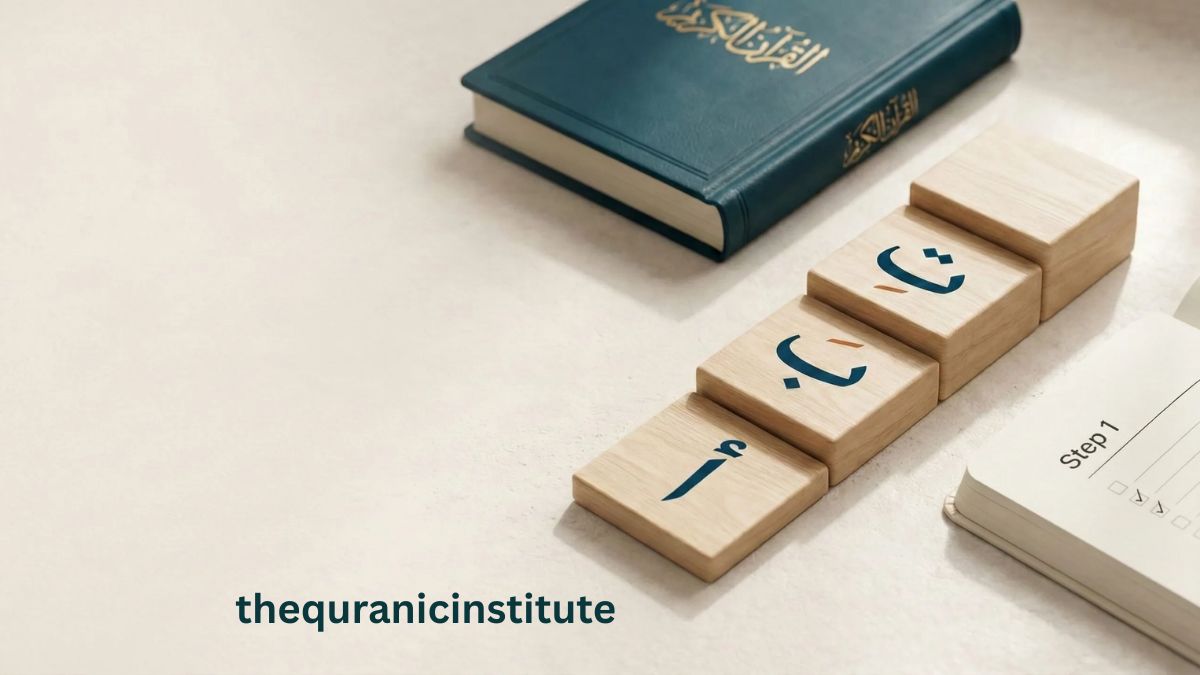
You need to learn the twenty-nine Arabic letters. These letters are also called Huroof al-Hijaiyya.
Arabic has twenty-eight letters. When we read the Quran, we count Hamza as a separate letter, so that makes twenty-nine. Each letter has a sound that is not always the same as the sounds in English. Some letters do not even have a sound in English. That is why it is so important to study Makharij.
The Quran says it was revealed in Arabic. This is written in Surah Ash-Shu’ara, verse 195. It says, “In an Arabic tongue.”
So every letter in Arabic should be pronounced correctly. When I teach, I always start by having my students listen to the sounds of the letters. They hear each letter several times before they try to write or read it. This helps them learn the sounds easily.
How Arabic Letters Change
Each Arabic letter can look different depending on where it’s in a word. Some letters have up to four forms. For example, the letter ع looks different at the start of a word than it does at the end.
It is an idea to make flashcards that show all the different forms of each letter. This can help you avoid getting confused. I have my students make their flashcards by hand. This helps them remember the letters better than reading them.
Short Vowels: Fatha, Kasra, Damma. The Basics of Sound
These three markings above or below letters help make vowel sounds.
Fatha makes an “ah” sound.
Kasra makes an “ee” sound.
Damma makes an “oo” sound.
Most mistakes when reading come from misreading or ignoring these vowel sounds.
When someone reads wrong, I check if they see these vowel sounds or skip them.
These vowel sounds are very important.
Tanween, Sukoon, and Shadda Explained Simply
Tanween makes a vowel sound longer and adds a nasal “n” sound.
Sukoon means a letter has no vowel sound.
Shadda means a letter is pronounced twice.
These three symbols are used a lot in the Quran.
Learning them early helps.
Step 2. Master the Points of Articulation
Every Arabic letter comes from a point in the mouth, throat, or nose.
That point is called Makhraj.
If you make a letter from the point, it changes the word and its meaning.
I explain it like this: imagine playing a note on a piano.
Makharij are like piano keys.
Get them right. The Quran sounds correct.
The 5 Main Articulation Zones Explained
| Zone | Letters |
|---|---|
| Throat | Hamza, Ha, Ain, Ghain, Kha, H |
| Tongue | Most Arabic letters |
| Lips | Ba, Meem, Waw, Fa |
| Nose | Ghunnah |
| Oral Cavity | vowels: Alif, Waw, Ya |
The Most Commonly Mispronounced Letters
The letters ع (Ain), غ (Ghain), ح (Ha), خ (Kha), ق (Qaaf), and ص (Saad) are hard for non-Arabic speakers.
Most students struggle with ع (Ain) the most.
It needs a sound from deep in the throat.
With practice, it gets easier, usually in two to three weeks.
Short Vowels like Fatha, Kasra, and Damma are the basics of Quran recitation.
To get started, you need to practice exercises to train your tongue and throat.
Start by practicing each letter on its own, then try saying it in simple syllables like Qa, Qi, Qu, and then use it in short words.
You should spend two to three minutes per letter every day.
I have seen that students who practice in front of a mirror improve faster because they can see how their lips and tongue are moving and correct themselves.
Recording yourself and listening to it is also very helpful. You can hear what you are doing wrong.
Step 3. Start with Noorani Qaida
Noorani Qaida is a book for beginners that teaches them how to recite the Quran.
It was written by Noor Muhammad Haqqani. It takes you from individual letters to joined letters to basic Tajweed rules.
Every beginner needs Noorani Qaida. It does not matter if you are an adult, a child, or a new Muslim.
There is no way to skip this step.
The Prophet said, “The best among you are those who learn the Quran and teach it.”
So learning Noorani Qaida is a step in learning the Quran.
It is where you really start your journey.
The Prophet said that you should learn and teach. So when you finish, you can teach others.
To progress through Noorani Qaida, start with letters and their sounds.
Then move on to letters with harakat like Fatha, Kasra, and Damma.
Next practice letters that are combined.
After that, practice words with Madd.
Finally, practice phrases from the Quran where you use everything you have learned.
Do not rush through any chapter. It is better to take your time and make sure you understand it.
I have seen students finish Noorani Qaida in six weeks. Then they have to start again because they did not learn it properly.
If you take your time, you will save time in the run.
It usually takes two to four months to complete Noorani Qaida if you practice every day for 20 to 30 minutes and have a teacher.
Children may take a bit longer. They tend to pronounce the words more accurately because they take their time.
You can buy the Noorani Qaida book or learn online at thequranicinstitute.com.
They have courses with teachers for students in the USA, UK, Canada, and Australia.
You can also find videos on YouTube. It is better to have a teacher who can correct you.
For learning, you can visit the Noorani Qaida course page.
Step 4. Learn the Core Tajweed Rules
To start with, I want to share a hadith that shows why this step is so important. The hadith says:
“Whoever reads a letter from the Book of Allah will receive a deed, and the good deed is multiplied by ten. I do not say that Alif Lam Meem is one letter. Alif is a letter, Lam is a letter, and Meem is a letter.”
This is from Sunan al-Tirmidhi, 2910.
So every letter we recite correctly gives us a reward. Every rule we apply makes our recitation more precise.
Let us keep this in mind as we work through the Tajweed Rules.
The Rules of Noon Sakinah and Tanween
These rules tell us what happens to a Noon Sakinah or Tanween when they come before letters.
There are four rules: Izhaar, Idghaam, Iqlaab, and Ikhfaa.
Izhaar means we say the letter clearly.
Idghaam means we merge the sound into the letter.
Iqlaab means we change the Noon sound to Meem with a ghunnah.
Ikhfaa means we say the letter with a sound, but not too loudly.
These rules appear several times in the Quran.
If we master these rules, our recitation will be much better.
When I teach these rules to beginners, I use a color-coded Mushaf.
This helps students see each rule in the verses of the Quran.
Seeing the rules in context helps students remember them faster than memorizing definitions.
The Rules of Meem Sakinah
These rules are for a Meem that is not followed by a vowel.
There are three rules for Meem Sakinah: Ikhfaa Shafawi, Idghaam Shafawi, and Izhaar Shafawi.
Ikhfaa Shafawi happens when Meem comes before Ba.
Idghaam Shafawi happens when Meem comes before another Meem.
Izhaar Shafawi happens when Meem comes before any letter.
This rule is easy to learn once we understand the Rules of Noon Sakinah.
I usually teach Meem Sakinah in the lesson as Noon Sakinah.
Students learn it quickly because the pattern is familiar.
Qalqalah
It is a bounce that we apply to five letters when they have a Sukoon: ق ط ب ج د.
The word “echoing” is a way to describe Qalqalah.
The sound bounces slightly at the point of articulation of stopping cleanly.
We can hear Qalqalah clearly in Surah Al-Ikhlas.
This is one of the recited surahs in the Quran.
The Arabic verse is: قُلْ هُوَ اللَّهُ أَحَدٌ
The English meaning is: “Say: He is Allah, the One.”
Listen to how a skilled Qari says the ق (Qaaf) in “Qul”.
That slight bounce is Qalqalah in action.
When I teach Noorani Qaida, I tell my students to exaggerate the bounce at first.
This helps their mouth find the movement.
Then they can soften it to the level naturally.
Madd Rules. Natural, Connected, and Separate
Madd is about how you hold certain vowel sounds in the Quran. Natural Madd is two counts. Other types like Madd Muttasil and Madd Munfasil are four or five counts, depending on the situation.
Allah tells us something about the Quran.
The Quran says: وَقُرْآنًا فَرَقْنَاهُ لِتَقْرَأَهُ عَلَى النَّاسِ عَلَىٰ مُكْثٍ وَنَزَّلْنَاهُ تَنزِيلًا. This is from Surah Al-Isra, 17:106.
It means: “And it is a Quran which We have separated so that you may recite it to the people over a period. We have revealed it progressively.”
The phrase “over a period” means you should recite the Quran slowly and carefully. Madd rules are not just things. They are part of how the Quran is supposed to be recited.
I tell my students to tap their fingers for each count while reciting. This makes the sound of the Madd clear and consistent.
Ghunnah. The Nasal Sound
Ghunnah is a sound that comes from the nose. It is used with Meem and Noon. Only in certain situations. When you do Ghunnah correctly, it makes the Quran sound beautiful.
To check if you are doing Ghunnah correctly, I tell my students to pinch their nose while making the sound. If the sound changes, you are doing it right. If not, you need to correct it.
Step 5. Learn When to Stop and Start
Incorrect Pausing Can Change the Meaning
Pausing at the time is not just a small mistake. It can completely change the meaning of a verse. Allah warns us about people who change His words.
The Quran says: يُحَرِّفُونَ الْكَلِمَ عَن مَّوَاضِعِهِ. This is from Surah An-Nisa, 4:46.
It means: “They distort words from their places.”
This is talking about people who do it on purpose. If you pause at the wrong time because you do not know any better, it still changes the meaning.
That is why we have Waqf rules. To make sure we understand what Allah is saying.
I had a student who used to pause in the middle of a verse, in Surah Al-Baqarah. She was connecting two ideas that Allah did not connect. When we looked at what her pause meant, she was very surprised. After that, she took the Waqf study seriously.
Common Waqf Symbols
Here are some symbols you will find in the Mushaf:
- م. You have to stop.
- لا. Do not stop here.
- ج. You can stop here.
- ص. You can stop, but it is better to keep going.
- ط. It is recommended to stop.
The Beginner Rule: When in Doubt, Which Pause is Safest?
When you are not sure, stop at the end of a verse. This is always safe. Stopping in the middle of a verse without knowledge of the rules can change the meaning. So when in doubt, finish the verse fully, take a breath. Start again from the next verse.
Step 6. Practice by Following a Reciter
Why Listening is a Way to Learn
Your ears are your best tools for learning at this stage. A long time ago, Muslims passed down the Quran by word of mouth from teacher to student. This is how the Quran was kept safe. Allah supports this way of learning by listening first:
Arabic: فَإِذَا قَرَأْنَاهُ فَاتَّبِعْ قُرْآنَهُ
Reference: Surah Al-Qiyamah, 75:18
English Meaning: “So when we have recited it, follow its recitation.”
You should listen first and follow. This is how the Prophet used to learn and pass on the Quran. It is still the way to learn Quran recitation today.
The Prophet loved to listen to Quran recitation from his friends.
“Allah’s Messenger said to me: ‘Recite the Quran to me.’ I said: ‘O Messenger of Allah, shall I recite it to you while it was revealed to you?’ He said: ‘I like to hear it from others.'” (Sahih al-Bukhari, 5049)
If the Prophet valued listening to the Quran from others, we should also use it as a tool for learning.
I have seen that beginners get faster when they listen before they read. Hearing the sound first helps your tongue to get it right.
How to Use the Repeat-After-Me Technique
- Play three to five verses from a reciter.
- Pause.
- Repeat aloud what you heard.
- Play again.
- Compare.
This way of learning helps you get the pronunciation faster than reading alone. Your brain learns the sound before you think about it.
Best Qaris Recommended for Beginners
- Sheikh Mahmoud Khalil Al-Husary is a starting point for beginners. His recordings pause after each phrase, which is designed for learners. He pronounces words clearly. Has been a standard for decades.
- Sheikh Abdullah Basfar recites at a pace with a clear voice.
- Sheikh Sa’d Al-Ghamdi has an easy-to-follow tone that many beginners find helpful.
Step 7. Learn Under a Qualified Teacher
Why Self-Teaching Has Limits in Quran Recitation
You can’t hear your own mistakes like a trained teacher can. When you learn by yourself, you get used to how you say things and can’t hear the errors. I have seen students who studied alone for a year and had mistakes in pronunciation that they didn’t even know about. Fixing those mistakes took a lot longer than learning from the start.
A teacher notices things that self-study doesn’t. This isn’t a sales pitch. It’s just how learning works when it comes to pronunciation.
The Concept of Isnad. The Chain of Transmission
Every good Quran teacher has an Isnad. This is a chain of teachers that goes all the way back to the Prophet. My own Isnad comes from scholars who know the Quran recitation tradition.
The Quran says:
“Indeed it is We who sent down the Reminder, and indeed We will be its guardian.” (Surah Al-Hijr, 15:9)
This is how Allah preserved the Quran. Through a chain of teachers. When you learn from a teacher with an Isnad, you are connecting to that preservation. You are not just reading rules from a book. You are part of a tradition.
How to Find a Qualified Quran Teacher Online
Look for teachers with an authorization in Quran recitation. Check if they are from a school. Some online academies have teachers who can show you their qualifications.
What to Look for in a Good Online Quran Academy
Here are four things to look for:
- A qualified teacher with an Isnad
- A clear plan of what you’ll learn
- A trial class to see if it’s a fit
- Feedback from students
If they can’t explain their teacher’s qualifications, it’s not worth your time.
If you are looking for a female instructor, read our guide on “Female Quran Teacher Online.”
Building a Daily Quran Reading Routine That Actually Works
Here’s a sample plan for beginners:
| Time | Activity |
|---|---|
| 0 to 5 min | Review what you learned before and your teachers notes |
| 5 to 15 min | New lesson (letters, rules or a chapter) |
| 15 to 22 min | Listen to someone recite clearly and repeat after them |
| 22 to 30 min | Practice reciting on your own |
This plan works because it starts with a review, then new material, listening, and practice. Each step helps your brain learn.
How to Track Your Progress Without Getting Overwhelmed
Keep a notebook. Write the date of what you practiced and one thing you found difficult. Review it every week. Patterns emerge fast. Patterns show you exactly where your attention needs to go.
Dealing with Plateaus. What to Do When Progress Feels Slow
Every learner hits a plateau around weeks six to eight. I tell my students this before it happens, so they are not surprised. It is not a failure. It is a consolidation. Your brain is quietly organizing everything it has learned. Reduce material practice, existing rules more, and listen more. Within a week or two, progress starts again.
The Prophet ﷺ said:
“Take on as much as you can handle, for Allah does not get tired of giving rewards until you get tired of doing good deeds.” (Sahih al-Bukhari, 43)
This hadith supports manageable practice.
Combining Meaning (Tafsir) with Recitation Practice
When you can recite a surah with accuracy, start exploring its meaning. Allah wants us to think deeply about His words:
Arabic: أَفَلَا يَتَدَبَّرُونَ الْقُرْآنَ أَمْ عَلَىٰ قُلُوبٍ أَقْفَالُهَا
Reference: Surah Muhammad, 47:24
English Meaning: “Then do they not reflect upon the Quran, or are there locks upon their hearts?”
Recitation and reflection go together. Tafsir Ibn Kathir and Tafsir al-Sa’di are starting points for English-speaking learners.
Common Mistakes Beginners Make When Reading the Quran
Rushing Through Verses Without Applying Rules
Speed feels like progress. It usually is not. Rushing creates habits, and those habits take a long time to correct. Slow down. Every verse deserves its right.
Skipping Makharij Practice and Going Straight to Surahs
This is like trying to sprint before learning to walk. Makharij is the foundation of recitation. Skipping it means every surah you recite has errors.
Memorizing Without Understanding Tajweed
Memorizing without Tajweed is like building a house on sand. You will memorize faster. Retain better when the rules make sense. Because the rules give structure to what you are memorizing.
Not Seeking Correction from a Live Teacher
This mistake wastes months or years of effort. Online platforms are supplements. Not substitutes. For qualified feedback. No app can replicate what a trained teacher hears in your recitation.
Inconsistency. The Biggest Enemy of Progress
Missing three days in a row resets more than most learners realize. Arabic phonetics require practice, especially in the early months. Treat your practice session like Salah. As a fixed commitment.
Best Resources for Beginners to Learn Quran Reading in 2026
Top Online Quran Academies (USA, UK, Canada, Australia)
For English-speaking students, thequranicinstitute.com offers beginner programs, with qualified teachers, flexible scheduling, and trial classes. Academies built for these markets understand the time zone realities and cultural context that students face.
Best Mobile Apps for Quran Learning
The Quran Learning apps are really helpful. Tarteel AI is one of them. It uses voice recognition to point out the mistakes you make when you recite the Quran. This is very useful when you are practicing on your own. Quran Majeed is another app that’s very helpful. It uses colors to show you the Tajweed rules when you read the Quran. These apps do not replace a teacher. They are very helpful when you use them with a plan.
YouTube Channels and Free Video Courses
There are YouTube channels that are very helpful for learning the Quran. Ustadh Wisam Sharieff has a series called “Quran Revolution” that’s very easy to understand. It is one of the resources for learning Tajweed in English. If you speak Urdu, there are Pakistani scholars who offer free courses on Tajweed. They focus on Makharij, which is very important.
Books and Physical Workbooks for Tajweed Practice
There is a book called “Tajweed Rules of the Quran” by Kareema Carol Czerepinski. It is a detailed book on Tajweed, and it has three volumes. It is the book on Tajweed in English. You can also use the Noorani Qaida book to practice Tajweed. It is a good book for beginners.
Quran Reading for Special Groups
How to Read the Quran Correctly as a Complete Beginner Adult
As an adult, you have one advantage over children. You can. Be disciplined. Use this to your advantage. Practice the Quran every day, even if it is for a little while. Focus on Makharij. Be honest with yourself about your mistakes. You will learn faster than you think.
Teaching Children to Read the Quran
If you want to teach your children to read the Quran, start with the basics. Teach them the letters and sounds of the alphabet. Use fun games and activities to make it interesting. Children learn fast at a young age, so start early. The Prophet Muhammad said that children should start praying when they’re seven years old. This means that they should also start learning the Quran at an early age. The Noorani Qaida book is a place to start.
Quran Reading for Converts
If you are new to Islam, do not worry if you do not know how to read the Quran. All the companions of the Prophet Muhammad were once beginners, too. Start with the basics. Read Surah Al-Fatiha and the short surahs in Juz Amma. Practice every day. Be sincere. Allah will guide you. Help you.
Can I Read the Quran Without Wudu?
Most scholars say that you need to be in a state of Wudu to touch the Quran. This is based on a verse in the Quran that says only pure people can touch it. If you are reciting the Quran from memory, you do not need to be in a state of Wudu. It is still a good idea to be in a state of Wudu as a sign of respect. If you are reading the Quran on a screen, the rules are a bit different. Some scholars say it is okay to read the Quran on a screen without Wudu. It is still better to be in a state of Wudu.
FAQ
How long does it take to learn to read the Quran?
If you practice every day, you can learn to read the Quran in six to twelve months. First, you need to complete the Noorani Qaida book, which takes two to four months. Then you can start practicing Tajweed with a teacher. With practice and patience, you can learn to read the Quran.
Can I learn to read the Quran on my own without a teacher?
You can learn some things by yourself. You cannot be sure you are saying the words correctly. A teacher can help you with the parts that’re hard to hear. You can use apps and videos to help. You should not use them instead of a real teacher.
What is the easiest Surah for beginners to start reading?
The Quran has Surahs that are good for beginners. Surah Al-Ikhlas has four parts, Surah Al-Kawthar has three parts, and Surah Al-Asr has three parts. These Surahs are good because they are short and easy to understand.
Do I need to understand Arabic to read the Quran?
No, you do not need to understand Arabic to read the Quran. Many people who do not speak Arabic can read the Quran well. Understanding the words can help you. It is not necessary to read the Quran correctly.
What is the difference between Tajweed and regular Quran reading?
Tajweed is a way of reading the Quran that follows certain rules. It helps you say the words correctly. If you do not use Tajweed, you might not be saying the words correctly. Tajweed is what makes reading the Quran truly beautiful.
At what age should a child start learning to read the Quran?
Most teachers think that children should start learning the Quran when they’re around four to six years old. They can start learning the letters and sounds even earlier.
Is it okay to use a transliteration guide when starting out?
It is not a good idea to use a transliteration guide for a long time. It can help you a bit at first, but it is better to learn the Arabic letters as soon as possible. If you use a transliteration guide for a long time, it can make it harder for you to say the words correctly.
How do I know if I am reciting the Quran correctly?
The best way to know if you are reciting the Quran correctly is to ask a teacher. You can record yourself. Listen to it, but a teacher can help you with the parts that are hard to hear.
Your Journey Begins with a Single Letter
Learning to read the Quran is not a test; it is a journey. It is a way to build a relationship with the words of Allah.
Allah says that He will guide us if we try our best.
The Quran says: وَالَّذِينَ جَاهَدُوا فِينَا لَنَهْدِيَنَّهُمْ سُبُلَنَا وَإِنَّ لَمَعَ الْمُحْسِنِينَ. This means that Allah will help us if we try our best.
So start learning the Quran today. Start with the alphabet, then learn Noorani Qaida and find a qualified teacher.
Your next step is simple: find a teacher. Start learning.
Every great reader of the Quran started where you are now. The only difference is that they kept trying and were brave enough to start.
About The Author
Written by Hafiza Asma
Hafiza • Alima • Master in Islamic Studies • SEO Content Specialist
Hafiza Asma has over 10 years of experience teaching Quran and Islamic studies to students across the USA, UK, Canada, and Australia. Through her teaching experience and work with qualified male and female Quran instructors, she focuses on making Islamic education simple, engaging, and comfortable for students of different age groups. Lessons are designed using age-appropriate language, real-life examples, and interactive learning techniques to help students understand and remember lessons effectively while learning with confidence and interest.
Visit us at: The Quranic Institute
